Below is a timeline for every notable event in the history of movies in the home (with more being added). It should be noted that this website uses the term, “Home Video,” in two different ways. Firstly, it uses it as an umbrella term for the viewing of movies in the home, physical or otherwise. Secondly, its also the label given to the era in time where movies are being released on physical video formats.

February, 1988 (Billboard, 1988/02/13, p. 4)

Super Source Video Releases the First 2 S-VHS Titles
Super Source Video releases the first two prerecorded S-Video releases. They are for the special interest titles, Impact Zone ($54.95) and River Song ($44.94). Up until 1991, they would release up to 38 titles on the format from various studios, including Paramount, New Line Cinema and Hemdale Home Video. Among these included Indiana Jones and the Last Crusade (1990), Top Gun (1986) and The Terminator (1984).
1988

The First Hollywood Video Opens
Mark Wattles registers the company name “Hollywood Entertainment” in Oregon on June 6th, 1988, and opens the first Hollywood Video location in Portland. It later becomes a mega chain.
1989 (Derran 1989 Catalog)

Derran Films Releases a Feature-Length Super 8 Release of “Star Wars”
Derran films in the U.K. releases a full-length print of Star Wars (1977) on Super 8. This is the only time that the the film is ever released in full to the public on film. It is on 4 600ft reels and is presented in scope. It sells for £289 (for the stereo version).
1990

Charlie Sheen Reports “Flower of Flesh and Blood” to the FBI
Film critic Chris Gore lends actor Charlie Sheen a stack of videotapes, and among them is a copy of the Japanese splatter film, Flower of Flesh and Blood (1985). Believing he was seeing an actual snuff film, he reports it to the FBI. After investigating the filmmakers, they find no one was harmed in the making of the movie.
October 16th, 1991 (Billboard, 1991/09/28, p. 10)

Philips CDI 910 (CD-i)
Philips launches their first CD-i system, the CDI 910 for $1000. At launch it has 30 titles titles available, which are interactive games and educational programs. Two years later, movies would be available on a sub-format specially made for digital video.
March, 1992 (Billboard, 1992/01/18, p. 54)

The Voyager Company Releases the First 3 Movies on CD-ROM
The Voyager Company, most notable at the time for their Criterion Collection line of laserdiscs, releases the first three feature-length movies on CD-ROM. They are the documentaries, “Poetry in Motion,” “To New Horizons: Ephemeral Films 1931-1945” and “You Can’t Get There From Here.” Later that year, they release the first Hollywood film, A Hard Day’s Night (1964), on the format. These are regarded as the first feature-length movies viewable on a PC.
June 2nd, 1993 (Billboard, 1993/06/19, p. 13)

Paramount Announces 50 Titles For CD-i (DV) Format
Paramount becomes the first studio to make their films available on Philip’s CD-i format, a system that had launched two years prior. But specifically for movies, Philips had developed a “Green Book” standard version of their disc, which they refer to as CD-i DV (digital video) or Full Motion Video (FMV). Movies are released on the format that November, and require a digital video expansion cartridge (approximately $200) which will allow the system to play the discs.
June 29th, 1993 (Billboard, 1993/07/10, p. 3)

4 Major Manufacturers Agree on Video CD
At the Fourth Multimedia Conference in London, Philips, Matsushita, JVC and Sony agree on the “White Book” standard for a new video disc, simply referred to as “Video CD.” The discs use MPEG-1 compression and hold up to 74 minutes per disc. The new format would replace Philip’s current CD-i (DV) format for movies. The discs are playable in either Panasonic’s 3DO system or Philip’s CD-i machines, but both require a digital video expansion card. Movies and standalone Video-CD players won’t be available until the following year.
May 24, 1994 (Billboard, 1993/05/24, p. 38)

Panasonic LX-HD10 (MUSE Hi-Vision)
Panasonic releases the LX-HD10, the first laserdisc player compatible with the new high-definition (hi-vision) MUSE format. At 1125 lines of resolution, MUSE discs have twice the clarity of standard laserdiscs. In US dollars, the LX-HD10 costs approximately $5,300, with discs themselves costing several hundred dollars. It is the very first high definition format for the home market.
November 1st, 1996 (Billboard, 1996/11/02, p. 8)

Toshiba SD-3000 (DVD)
Toshiba releases the world’s very first DVD player in Japan for approximately $700. The first two DVD titles released in the region are two “long-form” music videos from artist, Eikichi Yazawa, selling for between $30 and $50.
February, 1997 (Los Angeles Times, 1997/02/07, p. F1)

Sirius Publishing Releases Their First 50 Titles on MovieCD
Sirius Publishing beats DVD to the market with their “MovieCD” discs. The discs offer “near VHS-quality,” and are playable in PCs with a CD-ROM drive. In their first 8 months, they reportedly sell approximately 300,000 discs through computer retail outlets. Their biggest selling point is their playability in laptops, allowing for “movies on the go.”
March 24th, 1997 (Billboard, 1997/04/12, p. 3)

Warner Home Video Releases the First 25 DVD Titles In the U.S.
In a soft test launch involving seven U.S. cities, Warner Home Video distributes their first 25 titles on the new DVD format (the first of which is the disaster film, Twister (1996)). Best Buy reveals that within the the first day of the format’s launch, they sold approximately 2,500 Warner DVDs from the 74 stores that carried the format.
April 21st, 1997 (PR Newswire, 1997/04/21, p. 1)

Reel.com Launches the First Online Movie Rental Service
Reel.com is the first to use an online ordering form for the rental of movies. They launch their service with 35,000 titles available for rent. Although much smaller websites, such as Home Film Festival (homefilmfestival.com), Video Wasteland (slaughter.net) and Video Vault (videovault.com) were already renting videos over the internet, they required calling or e-mailing an order in.
April, 1998 (Billboard, 1998/05/16, p. 53)
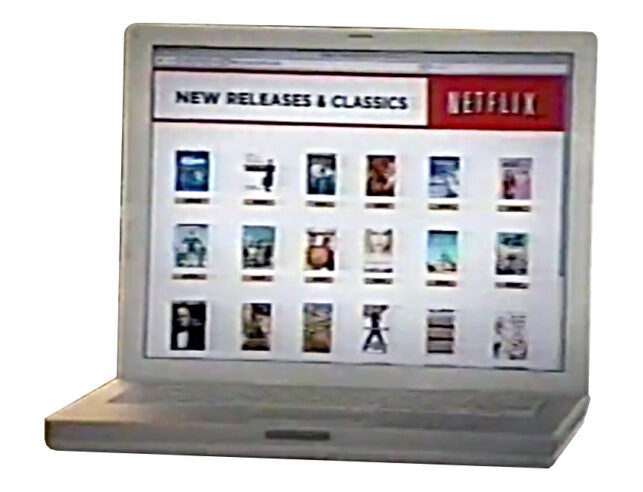
Netflix Launches Online DVD Rentals and Sales
With the company established the previous year, Netflix launches their online DVD rental service with 925 titles available for rent for $5 each.
June 8th, 1998 (Billboard, 1998/06/13, p. 79)

DIVX Discs are Test Launched
DIVX discs are launched as an alternative to traditional rental systems. A DIVX disc could be purchased for less than $5 (average price of a rental). Upon playing the disc, he or she would have a 48 hour window to watch the program. They could then extend this viewing period for an additional fee (which required the DIVX player to be connected to the internet via a telephone line). The format was discontinued on June 16th, 1999.
March 31st, 1999 (Tivo, Asselin, 2013, p. 42)

Philips HDR110 (TiVo DVR)
TiVo launches the first consumer DVR device. Like the VCRs before it, the device is primarily used to time-shift television programming. But unlike VCRs, they are digital and allow the pausing and rewinding of live TV. This first TiVo device, the HDR110, had a 14GB hard drive which could record up to 14 hours of content.
June 1st, 1999

Napster Launches the First Widely Popular Peer-to-peer Network
Although mainly a music sharing platform (due to internet speeds at the time), it paved the way for subsequent peer-to-peer sharing programs that would allow the sharing of all files, including videos.