Below is a timeline for every notable event in the history of movies in the home (with more being added). It should be noted that this website uses the term, “Home Video,” in two different ways. Firstly, it uses it as an umbrella term for the viewing of movies in the home, physical or otherwise. Secondly, its also the label given to the era in time where movies are being released on physical video formats.

November 23rd, 1984

Columbia Pictures vs. Redd Horne Inc.
Courts decided that renting out private booths for the viewing of movies constitutes as a public viewing, and therefore, violates copyright. The store in question was Maxwell’s Video Showcase in Eerie, Pennsylvania.
December, 1984

The Criterion Collection Releases Their First 2 Titles
The Criterion Collection releases their first two titles, Citizen Kane (1941) and King Kong (1933), to laserdisc. Citizen Kane is priced at $89.95, while King Kong is priced at $74.95. Criterion promises the editions offer “the best picture quality ever seen.”
December, 1984 (Video Review, 1985/01)

The Very First Audio Commentary Track Is Released
The Criterion Collection’s laserdisc release of King Kong (1933) offers the very first audio commentary track for a feature film. It’s recorded by film historian and preservationist, Ronald Haver.
January, 1985 (Billboard, 1985/01/19, p. 3)

Paramount Home Video Starts a Price War
Paramount Home Video begins a year long campaign to drop the retail prices of their videocassettes in order to meet specific sales goals. The plan begins with Star Trek III (1984) at $29.99 and ten episodes of the original series at $14.99 each. This kicks off a “price war” amongst the studios, and is the industry’s third push towards a sell-through market..
1985

The First Movie Gallery Opens
Partners Joe Malugen and Harrison Parrish open the very first Movie Gallery store in Dothan, Alabama.
February, 1985 (Variety, 1985/02/13, p. 51)

MGM/UA Junks 30,000 Copies of “Gone With the Wind”
MGM/UA learns that approximately 30,000 copies of the Gone With the Wind (1939) has 45 seconds of the wrong music. According to the studio, because the copies used music from the international version of the film, they have to discard them.. The mistake costs the studio $100,000. This release is also the very first special collector’s edition on videocassette.
March, 1985

“Blood Cult” Is Marketed As the First Horror Film Made for Video
United Home Entertainment markets their in-house film, Blood Cult (1985), as the first horror film made directly for the home video market. Although it’s not the first horror film to skip theatrical, it is believed to be the first made with the sole purpose of distribution on the home market.
April 24th, 1985 (Billboard, 1985/05/04, p. 1)

“The Cotton Club” Is the First Title to Utilize Macrovision
Embassy Entertainment’s release of “The Cotton Club” is the first home video released with the new copy-protection system from Macrovision. All the major studios follow suit.
May, 1985 (Variety, 1985/04/24, p. 63)

The First Colorized Films are Released on Video
The first colorized black-and-white films are released on home video by Hal Roach Studios. The first is for the 1937 Cary Grant film, Topper. The concept of film colorization caused quite a controversy at the time, with many believing that the process impeded upon the intentions of the original filmmakers.
December, 19th, 1985

The First Blockbuster Video Opens
The first Blockbuster rental store opens in Dallas, Texas by software engineer David Cook and his ex-wife. Their goal is to make their store a family-oriented superstore. On opening day, it has a massive selection of 8,000 titles.
June, 1986 (Billboard, 1986/03/29, p. 53)

RCA Discontinues Manufacturing CED Discs
RCA begins the process of shutting down their only CED manufacturing plant on Rockville Road in Indianapolis, Indiana. Their final disc is an “experimental” souvenir disc for all plant employees called, Memories of Videodisc (1986).
June, 1986 (Billboard, 1986/04/19, p. 1)

Paramount Releases the First Major Titles on Video8 (8 mm)
Two years since the launch of the camcorder format by Kodak, Paramount becomes the first major studio to distribute titles on the Video8 / 8 mm format. Other studios would follow suit, including Embassy, RCA/Columbia and MGM/UA. By the February 1987, there are reportedly 800 titles on the format. The very first title was Tina Turner: Private Dancer, released the previous year by Sony Video Software. Prerecords continued to be released up through the mid-90s.
1987
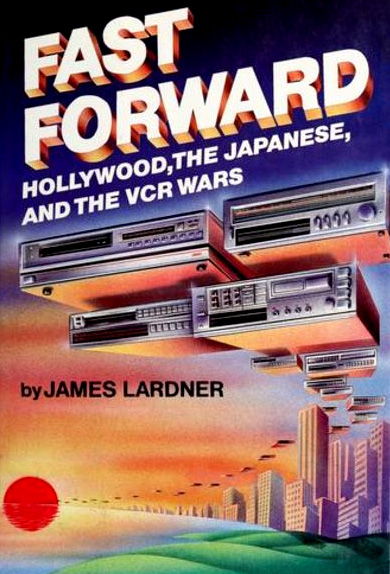
James Lardner’s Book “Fast Forward” Is Published
James Lardner’s account of the video industry, Fast Forward, is released. Its the first book to thoroughly document the rise of the VCR and the resulting legal battles.It includes interviews with such pioneers as Andre Blay and George Atkinson.
March 11th, 1987 (Billboard, 1987/03/11, p. 1)

The First Commercial Is Placed on a Major Home Video Release
Top Gun (1986) becomes the very first videocassette of a major film with a product commercial. In collaboration with Paramount Home Video, Pepsi places a 60-second ad before the start of the film. Because of the commercial, Paramount reduces the price of the videocassette $3 less than what it would’ve cost without it. Its listed at $26.95.
April, 1987 (Billboard, 1987/11/07, p. 58)

JVC HR-S7000 (S-VHS)
JVC introduces their first S-VHS (Super-VHS) VCR to the Japanese market, and then to the American market several months later in July for $1300. The new format offers 400 lines of resolution in comparison to standard VHS’s 240.
June 1st, 1987 (Variety, 1987/05/20, p. 86)

Pioneer CLD-1010 (CD-Video)
The first laserdisc player compatible with the upcoming CD-Video (CDV) is launched by Pioneer with a price tag of $800. Later that year, the discs are released. They contain 20 minutes of digital audio, and 5 minutes of analog (laserdisc) video. These are the first 5″ discs to contain video.