It should be noted that this website uses the term, “Home Video,” in two different ways. Firstly, it uses it as an umbrella term for the viewing of movies in the home, physical or otherwise. Secondly, its also the label given to the era in time where movies are being released on physical video formats. By default, the timeline below displays all events (with more always being added). Because the timeline has many events, use the buttons below to narrow down your interests.

June, 1986 (Billboard, 1986/03/29, p. 53)

RCA Discontinues Manufacturing CED Discs
RCA begins the process of shutting down their only CED manufacturing plant on Rockville Road in Indianapolis, Indiana. Their final disc is an “experimental” souvenir disc for all plant employees called, Memories of Videodisc (1986).
June, 1986 (Billboard, 1986/04/19, p. 1)

Paramount Releases the First Major Titles on Video8 (8 mm)
Two years since the launch of the camcorder format by Kodak, Paramount becomes the first major studio to distribute titles on the Video8 / 8 mm format. Other studios would follow suit, including Embassy, RCA/Columbia and MGM/UA. By the February 1987, there are reportedly 800 titles on the format. The very first title was Tina Turner: Private Dancer, released the previous year by Sony Video Software. Prerecords continued to be released up through the mid-90s.
1987
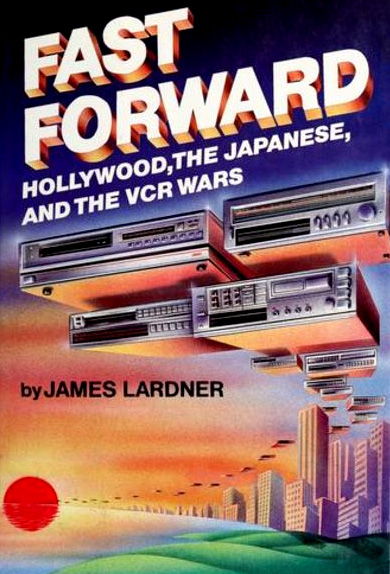
James Lardner’s Book “Fast Forward” Is Published
James Lardner’s account of the video industry, Fast Forward, is released. Its the first book to thoroughly document the rise of the VCR and the resulting legal battles.It includes interviews with such pioneers as Andre Blay and George Atkinson.
March 11th, 1987 (Billboard, 1987/03/11, p. 1)

The First Commercial Is Placed on a Major Home Video Release
Top Gun (1986) becomes the very first videocassette of a major film with a product commercial. In collaboration with Paramount Home Video, Pepsi places a 60-second ad before the start of the film. Because of the commercial, Paramount reduces the price of the videocassette $3 less than what it would’ve cost without it. Its listed at $26.95.
April, 1987 (Billboard, 1987/11/07, p. 58)

JVC HR-S7000 (S-VHS)
JVC introduces their first S-VHS (Super-VHS) VCR to the Japanese market, and then to the American market several months later in July for $1300. The new format offers 400 lines of resolution in comparison to standard VHS’s 240.
June 1st, 1987 (Variety, 1987/05/20, p. 86)

Pioneer CLD-1010 (CD-Video)
The first laserdisc player compatible with the upcoming CD-Video (CDV) is launched by Pioneer with a price tag of $800. Later that year, the discs are released. They contain 20 minutes of digital audio, and 5 minutes of analog (laserdisc) video. These are the first 5″ discs to contain video.
February, 1988 (Billboard, 1988/02/13, p. 4)

Super Source Video Releases the First 2 S-VHS Titles
Super Source Video releases the first two prerecorded S-Video releases. They are for the special interest titles, Impact Zone ($54.95) and River Song ($44.94). Up until 1991, they would release up to 38 titles on the format from various studios, including Paramount, New Line Cinema and Hemdale Home Video. Among these included Indiana Jones and the Last Crusade (1990), Top Gun (1986) and The Terminator (1984).
1988

The First Hollywood Video Opens
Mark Wattles registers the company name “Hollywood Entertainment” in Oregon on June 6th, 1988, and opens the first Hollywood Video location in Portland. It later becomes a mega chain.
1990

Charlie Sheen Reports “Flower of Flesh and Blood” to the FBI
Film critic Chris Gore lends actor Charlie Sheen a stack of videotapes, and among them is a copy of the Japanese splatter film, Flower of Flesh and Blood (1985). Believing he was seeing an actual snuff film, he reports it to the FBI. After investigating the filmmakers, they find no one was harmed in the making of the movie.
March, 1992 (Billboard, 1992/01/18, p. 54)

The Voyager Company Releases the First 3 Movies on CD-ROM
The Voyager Company, most notable at the time for their Criterion Collection line of laserdiscs, releases the first three feature-length movies on CD-ROM. They are the documentaries, “Poetry in Motion,” “To New Horizons: Ephemeral Films 1931-1945” and “You Can’t Get There From Here.” Later that year, they release the first Hollywood film, A Hard Day’s Night (1964), on the format. These are regarded as the first feature-length movies viewable on a PC.
October 16th, 1991 (Billboard, 1991/09/28, p. 10)

Philips CDI 910 (CD-i)
Philips launches their first CD-i system, the CDI 910 for $1000. At launch it has 30 titles titles available, which are interactive games and educational programs. Two years later, movies would be available on a sub-format specially made for digital video.
June 2nd, 1993 (Billboard, 1993/06/19, p. 13)

Paramount Announces 50 Titles For CD-i (DV) Format
Paramount becomes the first studio to make their films available on Philip’s CD-i format, a system that had launched two years prior. But specifically for movies, Philips had developed a “Green Book” standard version of their disc, which they refer to as CD-i DV (digital video) or Full Motion Video (FMV). Movies are released on the format that November, and require a digital video expansion cartridge (approximately $200) which will allow the system to play the discs.
June 29th, 1993 (Billboard, 1993/07/10, p. 3)

4 Major Manufacturers Agree on Video CD
At the Fourth Multimedia Conference in London, Philips, Matsushita, JVC and Sony agree on the “White Book” standard for a new video disc, simply referred to as “Video CD.” The discs use MPEG-1 compression and hold up to 74 minutes per disc. The new format would replace Philip’s current CD-i (DV) format for movies. The discs are playable in either Panasonic’s 3DO system or Philip’s CD-i machines, but both require a digital video expansion card. Movies and standalone Video-CD players won’t be available until the following year.
May 24, 1994 (Billboard, 1993/05/24, p. 38)

Panasonic LX-HD10 (MUSE Hi-Vision)
Panasonic releases the LX-HD10, the first laserdisc player compatible with the new high-definition (hi-vision) MUSE format. At 1125 lines of resolution, MUSE discs have twice the clarity of standard laserdiscs. In US dollars, the LX-HD10 costs approximately $5,300, with discs themselves costing several hundred dollars. It is the very first high definition format for the home market.
November 1st, 1996 (Billboard, 1996/11/02, p. 8)

Toshiba SD-3000 (DVD)
Toshiba releases the world’s very first DVD player in Japan for approximately $700. The first two DVD titles released in the region are two “long-form” music videos from artist, Eikichi Yazawa, selling for between $30 and $50.